

Drainage Channels
Slot Drains
Industrial Floor Drains
Floor Drains
Linear Shower Drains
Stainless Steel Covers and Grates
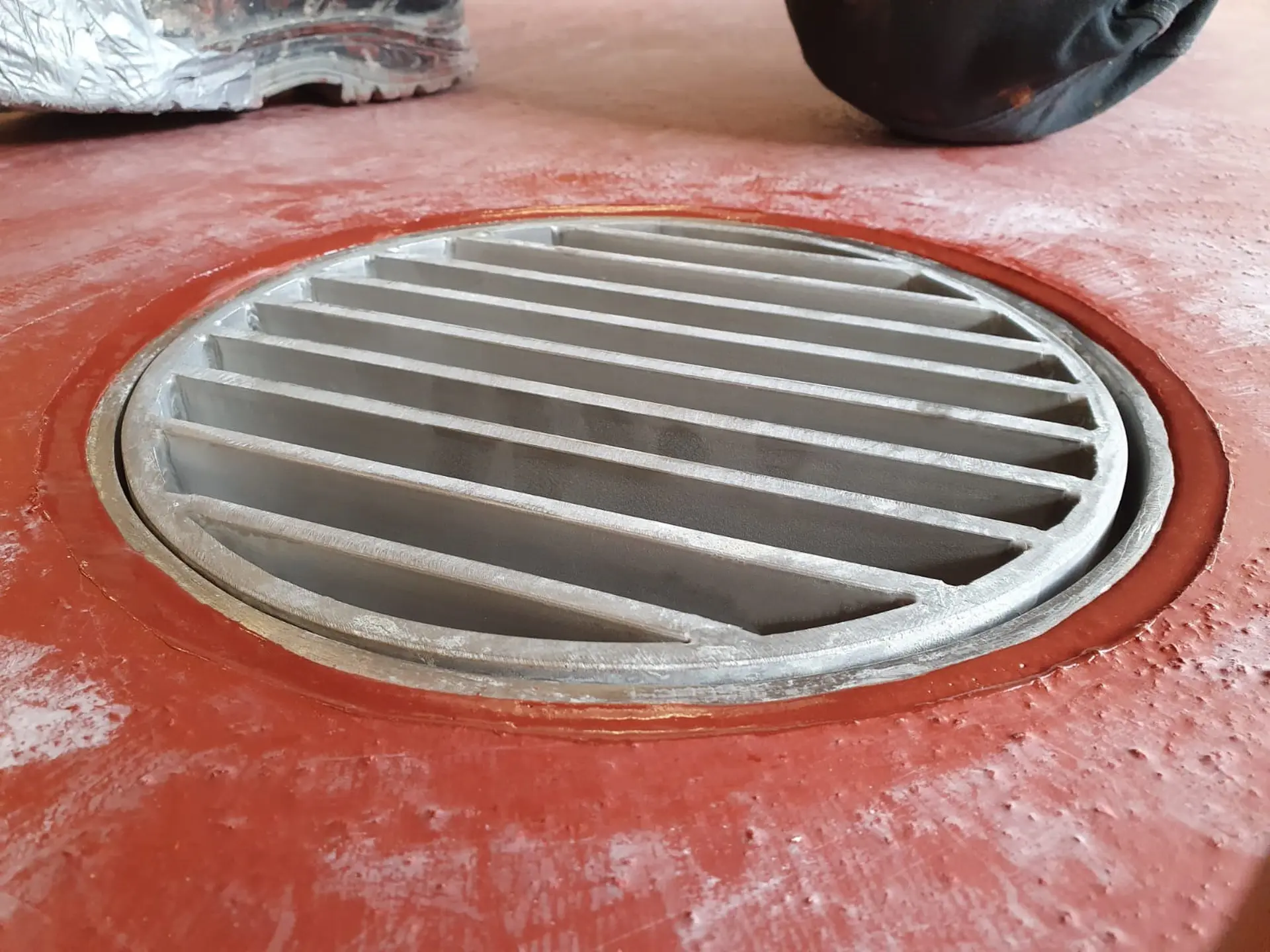

Industrial floor drains made of stainless steel V2A (1.4301) or V4A (1.4571) — available in one-piece and two-piece versions with height adjustment 50–160 mm. Vertical or horizontal outlet, square bodies 200×200 to 400×400 mm and round 210 or 300 mm, outlets DN 75–DN 200. Removable trap and sediment basket, choice of grates and covers.
An industrial floor drain collects water and process wastewater at a single point in the floor. It is ideal where liquid appears locally — at washing stations, individual machines, technical rooms and staff facilities. Where water flows across the entire surface, a drainage channel is the better solution; both systems often operate side by side in the same hall.
B&K GROUP floor drains are manufactured from stainless steel grades V2A (1.4301) and V4A (1.4571). Smooth surfaces and tight joints simplify cleaning, which is essential in facilities with high hygiene requirements.
The difference lies in height adjustment.
The second parameter depends on the ceiling construction and pipe routing. A vertical outlet directs flow downward and requires space beneath the floor. A horizontal outlet discharges sideways — used in low-build situations and thin floor layers where a vertical connection is not possible.
Standard square bodies measure 200×200, 250×250, 300×300 and 400×400 mm; round bodies are 210 and 300 mm. Outlets are available in DN 75, DN 110, DN 160 and DN 200. Smaller bodies accommodate DN 75 and DN 110, while larger bodies accommodate DN 110, DN 160 and DN 200.
Non-standard dimensions are produced to order according to the client’s technical documentation.
V2A (1.4301) is suitable for most industrial applications involving moisture and standard cleaning agents.
V4A (1.4571) offers higher corrosion resistance and is recommended for aggressive environments such as car wash facilities.
Floor drains are available in load classes H1.5, K3, L15, R50, M125 and N250. The class is selected according to the point load at the installation location, not the total vehicle weight. We assist with selection during quotation.
Each drain is supplied with a removable trap and sediment basket. The trap prevents odours from entering the room; the basket captures sand and debris before they reach the drainage system.
Both components can be removed without dismantling the drain, simplifying routine maintenance — especially important where daily cleaning is required.
We also supply inspection chambers that provide service access to the drainage installation:
Stainless steel floor drains are installed in food and beverage production plants, pharmaceutical facilities and general industrial engineering. They function both as standalone point drainage and as elements integrated with linear channels. Three factors are decisive: steel grade, correctly selected load class and ease of cleaning.
Floor drains form part of a wider system — the complete drainage range is available in the drainage systems section.